Article content
29 December 2025 by David Warne
Marrakech has attracted travellers, musicians and artists for decades and, for most visitors, especially first-timers, a stay in a riad is an essential part of any trip to Morocco. However, this city offers an almost bewildering choice of accommodation options, from sprawling ultra-modern resorts to historic villas in various neighbourhoods across the city and beyond – so how do you choose where to stay?
What defines a riad?

Villa des Orangers
The word riad has its origins in the Arabic for garden, a nod to one of the main features of this uniquely Moroccan style of dwelling, where a rectangular building surrounds a central, open-air courtyard containing a fountain and often trees or plants. Typically riads have more than one level and are inwardly focused for privacy and protection from the weather. Indeed, most riads have few, if any, outward facing windows and are often only accessible by a single doorway in a solid wall within the medina. Not only are they extremely private but they are also designed to keep out the noise of medina and so are often surprisingly peaceful places. And, whilst not all traditional riads were necessarily grand or large buildings, most of the ones you will encounter today in Morocco once belonged to wealthy merchants and courtiers.
How do you choose a luxury riad for the perfect stay?
There is a seemingly endless choice of riads, which by their very nature are notoriously difficult to categorise using traditional hotel star ratings. They are usually very small, don’t necessarily offer hotel-style facilities and – in an attempt to offer authenticity – retain original features that can make a riad look anything from stunningly beautiful to slightly dilapidated.
At one level, whichever riad you choose you will have a uniquely Moroccan experience as there simply isn’t anywhere else that offers this form of accommodation. Many are owned by wealthy expats who have bought the crumbling riads over recent decades and taken great effort to renovate them, adding the minimum of mod cons here and there where necessary.
At this point it is worth highlighting that bedrooms in riads are often by their nature dark, often without external windows at all or with small windows looking into internal courtyards. If you prefer lots of natural light other accommodation options and areas of the city might be a better bet - with the notable exception of Riad Farnatchi, which is detailed below. Similarly, not all have lifts an d some have uneven floors, so anyone with limited mobility may have to be careful when choosing a riad.
Where the differences between riads become more apparent is in the service, facilities and dining options. With this in mind, four properties in the medina stand out at the luxury level.
Villa des Orangers
Villa des Orangers
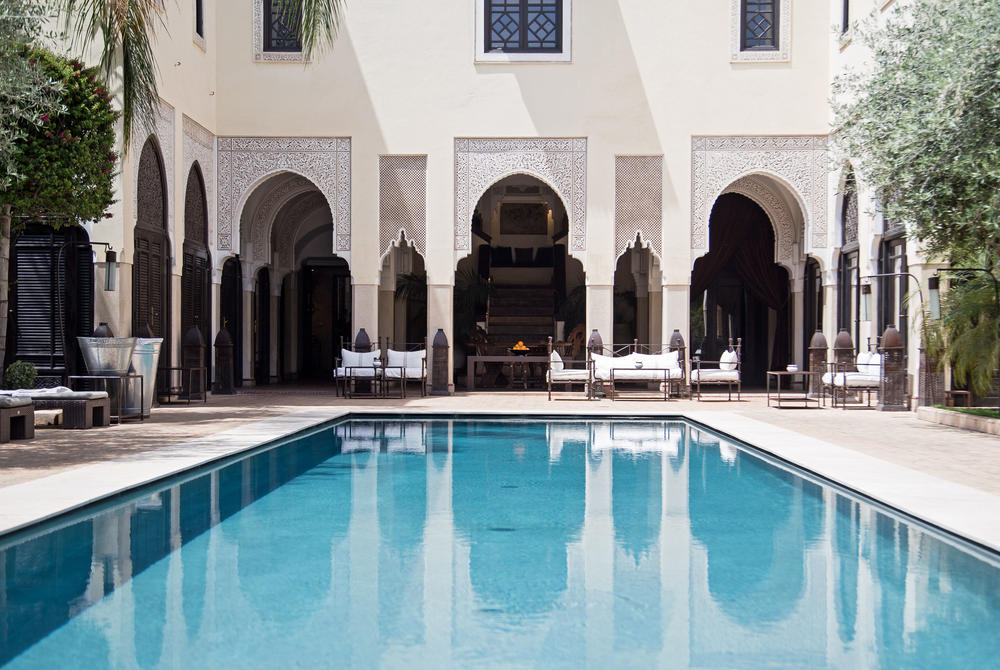
The beautiful Villa des Orangers – the only Relais and Chateaux property within the medina itself – is arguably the most luxurious of the historic riads and one of the best located. The present day hotel is composed of two early 20th century mansions with gorgeous suites, each unique and some with private roof terraces, and a superb restaurant with indoor and outdoor dining areas. Breakfast is taken in the wonderful courtyard garden and the property also offers a complimentary light lunch each day which is a nice touch if you are not out exploring. Being slightly larger than a typical riad, the property offers not only a larger than normal outdoor pool but two further plunge pools – one on the roof terrace offering views of the nearby Koutoubia. A beautiful spa and traditional hammam complete the line-up of facilities. Service is what you would expect from Relais and Chateaux, personal, attentive and courteous.
La Sultana
Close by and equally well-located in the historic Kasbah area of the medina is La Sultana, a 28-room property created from five separate but interconnected riads. Each individual riad has its own style and wandering through the maze-like structure is a pleasure in itself. La Sultana has a small outdoor pool in a charming traditional brick courtyard on the ground floor with an adjacent restaurant. The star of the show, however, is the wonderful rooftop which offers a further restaurant, bar and seating areas, ideal for a sundowner in the company of the clacking storks that inhabit the roof of the adjacent Saadian Tombs. The hotel also offers popular cooking classes on the rooftop every morning, an award-winning spa and various quiet courtyards to relax in, so you might find it hard to tear yourself away. Service here is exemplary, with natural warmth that makes you feel like part of the family.
Both La Sultana and Villa des Orangers are easy to access by car, which is not the case for many riads, making arrival and departure easier than most.
Riad Kniza

Riad Kniza
Our third recommendation at the luxury end of the scale is Riad Kniza, the only 5-star riad still in the hands of the original Moroccan family of owners. This riad offers arguably the most authentic experience of our selection, and being smaller than the others, is the most traditional in layout. It is also deep in the medina up a winding alley (it can be rather tricky to find at first) adding to the sense of place. It offers a small restaurant specialising in Moroccan cuisine, a wonderful rooftop and an indoor pool.
Le Farnatchi
Owned and lovingly nurtured by British hotelier James Wix, this intimate riad unfolds around a peaceful courtyard rich in traditional craftsmanship, from carved plasterwork to elegant zellij tiles. With just ten individually designed suites, each space thoughtfully styled with bespoke furnishings, air-conditioning and indulgent Egyptian cotton linens. One of the many standout features of Le Farnatchi is the sense of light and space throughout the riad, with white walls and more natural light from exterior windows than many other riads offer. A glorious rooftop offers a pool, garden area and bar terrace, which offers a serene setting for breakfast or evening drinks above the medina’s rooftops. The acclaimed restaurant, Le Trou au Mur, brings refined Moroccan flavours to the table and is well worth a visit even if not staying here.
 Le Farnatchi
Alternative hotels in the medina
Our recommended selection of hotels below are all located within the medina and still provide that all-important sense of place.
La Maison Arabe is something of a Marrakech institution and known above all for its two excellent restaurants. Although technically not a riad in the true sense of the word, it is every bit a Moroccan experience. Its famous bar, suitably dimly lit, has the feel of a 1930's drinking den, where you can almost hear the conspiratorial colonial murmurings seeping from the walls. Like the restaurants, the bar is open to non-residents, making it an atmospheric venue for a pre-dinner drink even if you are not staying here.

La Maison Arabe
Marrakech’s most famous hotel, La Mamounia, located just inside the medina walls, is a large resort-style hotel with superb facilities and beautiful grounds. It offers several restaurants (with Michelin star dining) a huge swimming pool and perhaps the most famous bar in Morocco, the Churchill Bar. The design of the hotel is contemporary Moroccan and there is perhaps more to experience within this hotel than any other within the medina, making it another great place to relax in between adventures.

La Mamounia
Palais Khum is another property that isn’t a true riad but still offers a great Marrakech experience, being a former foundouk (trading house). This property is unusual at its lower price point, as it offers a wider range of indoor and outdoor terraces than most, with indoor and outdoor pools and plenty of sun loungers, making it a great place to relax in between venturing out into the city. Service can, however, be a little patchy.
Just the other side of the medina walls from La Mamounia is the Hivernage district, which is home to a wide choice of large, resort-style hotels and some of the city’s top nightlife spots, such as the ever-popular Comptoir Darna. Whilst still conveniently located for the medina this remains a calm and relaxing neighbourhood to be based in and quite a contrast to staying within the medina itself.
Most of the hotels in the Hivernage are officially 5-star, but they generally don’t offer the charm or ambiance of a riad and service isn’t as personal or consistent as the equivalent standard riads. However, most offer good facilities, spacious grounds, large swimming pools and multiple dining and drinking options. Perhaps the best of the bunch in this area is the family-owned Es Saadi Palace – not to be confused with the adjacent, rather dated Es Saadi Hotel – offering huge rooms and the largest swimming pool in the city.
Ultra-luxury resorts
Further away from the medina and dotted around the city suburbs are several ultra-luxury resorts that are located in their own exclusive compounds. Amongst the best of these are the superb, contemporary Mandarin Oriental – which offers some of the largest and most exclusive contemporary villas in all of Morocco - the ever-popular Amanjena, fresh from a recent renovation, and the Selman, which, with its on-site stables, will appeal to horse lovers.
These resorts are all located a good 15-25 minutes’ drive from the medina, so you can feel a little detached from the heart of the city. However, all three properties are renowned for service and may suit luxury travellers looking primarily for a resort-style experience and only wishing to dip in and dip out of the hubbub of the medina when it suits.
And finally, a special mention must be made of the extraordinary Royal Mansour, which offers unparalleled exclusivity and service for the ultra-well-heeled. This most luxurious of luxury hotels offers guests entire riads for their exclusive use. Whilst purpose-built - and perhaps lacking the sense of history offered by the top riads in the Medina - this truly palatial hotel was built to exacting standards, with no expense spared on the design, artwork, and facilities. The exclusive, private environment means that the property doesn’t feel like a medina property at all, despite being within the city walls. And despite the attempt to bring the feel of the medina into the property, it can feel a little contrived to some visitors, and such opulence inevitably comes at a price.
My own preference is to embrace the true medina experience, especially on a first trip to Marrakech, as you simply can’t beat the buzz. And there is something magical about walking through an anonymous doorway in one of the city’s ochre-coloured walls into an ornately tiled courtyard to a soundtrack of tinkling fountains and rustling leaves. And don’t get hung up on whether any of the medina properties above are genuine riads or not – you’ll be hard pressed to tell the difference. If you need help finding the perfect accommodation for your stay, don't hesitate to get in contact with our travel specialists for expert, knowledgeable advice.